Buying guide
Best Yacht for Blue Water Cruising
A blue water cruising yacht must combine seaworthiness, range, and comfort for extended offshore passages in open ocean. The best blue water cruisers feature full displacement or semi-displacement hulls with deep keels, enclosed pilot houses or cabins, fuel capacity exceeding 1,000 gallons, and proven offshore construction—typically 40–60 feet in length. Cruising sailboats with cutter rigs, trawler yachts with redundant systems, and modern sportfish convertibles equipped with long-range fuel tanks all excel in blue water service. Critically, a blue water cruising yacht must have reliable navigation electronics, storm capabilities, and sufficient headroom and galley facilities for crews spending weeks at sea. Budget $400,000–$2 million depending on size, age, and build quality; factor in 15–25% annual operating costs for fuel, insurance, and maintenance on vessels designed for sustained offshore work.
What Defines a Blue Water Cruising Yacht?
Blue water cruising yachts are purpose-built or extensively modified vessels designed to safely cross oceans and handle heavy seas for extended periods. Unlike coastal cruisers, blue water boats must withstand breaking waves, extended periods without landfall, and self-sufficiency in remote waters. The hull design is paramount: full or semi-displacement hulls with deep keels provide stability and sea-kindliness in rough conditions, while planing hulls sacrifice comfort but gain speed for faster passages.
A true blue water cruising yacht incorporates several non-negotiable features. The cabin must be completely enclosed with storm shutters or ports, protecting crew from spray and weather. The galley and head systems need redundancy—backup water makers, multiple fuel sources, and manual bilge pumps independent of electrical systems. Navigation equipment includes redundant GPS, chartplotters, and radio communication systems (SSB or satellite phone). Fuel capacity should support 1,500–3,000 nautical miles of range, enabling passages between supply points without refueling at sea.
Proven construction matters enormously. Fiberglass layup must be solid laminate or balsa-cored with marine-grade resin systems. Steel or aluminum hulls are common in cruising trawlers and expedition yachts because they resist impact and corrosion better than fiberglass in remote waters where haul-out facilities are scarce. The best blue water cruising yachts have been tested by owners in real offshore conditions—look for models with a documented cruising history in the Pacific, Atlantic, or Indian Oceans.
How Much Length Do You Need for Blue Water Cruising?
Blue water cruising yachts range from 35 to 70+ feet, but the optimal size balances seaworthiness, crew comfort, and operational cost. Vessels under 40 feet are lighter, more fuel-efficient, and easier to maintain, but they offer cramped accommodations and reduced stability in extreme seas. A 40–50 foot blue water cruising yacht represents the practical sweet spot: large enough to provide comfortable berths for two to four crew, adequate fuel and water storage, and sufficient freeboard to shed water in rough conditions, yet still manageable for a couple to operate and maintain.
The 2026 Freeman 47LX exemplifies this size class. Freeman builds semi-custom trawler yachts with full displacement hulls, excellent sea-keeping characteristics, and the range required for blue water cruising. At 47 feet, the Freeman offers a proper pilothouse, multiple staterooms, and fuel capacity supporting transoceanic passages.
Vessels 50–60 feet provide enhanced comfort and redundancy but require larger crews or more demanding single-handed sailing techniques. Anything over 60 feet enters expedition-yacht territory, where operating costs and crew requirements become substantial. For most cruising couples, 40–48 feet represents the optimal balance for blue water cruising.
Which Hull Types Perform Best Offshore?
Blue water cruising yachts employ three primary hull designs, each with distinct offshore characteristics.
Full Displacement Hulls are the gold standard for blue water cruising. These hulls are designed to push water aside rather than plane over it, creating a stable platform that rises and falls with waves rather than crashing through them. Full displacement vessels achieve modest speeds (8–12 knots) but excel in fuel efficiency and sea comfort. Most cruising trawlers and traditional sailing yachts use full displacement designs. They're inherently seaworthy and forgiving in heavy weather, making them ideal for crews prioritizing safety and comfort over speed.
Semi-Displacement Hulls (also called semi-planing) represent a compromise. They displace more water than planing hulls but can achieve 15–18 knots when fuel-efficient, providing faster passages than full displacement vessels while retaining much of their sea-kindliness. Semi-displacement designs work well for blue water cruising yachts where crews want reasonable speed without sacrificing offshore capability. The Freeman 47LX and similar trawler-style yachts often feature semi-displacement hulls optimized for this balance.
Planing Hulls are common in sportfish and center console yachts. They're designed to lift onto a plane and achieve 20+ knots, making them fast for reaching fishing grounds or cruising destinations quickly. However, planing hulls pound and pitch in heavy seas, reducing comfort and increasing fuel consumption in rough conditions. Modern sportfish designs with deep V-hulls and wide beams have improved offshore capability, but they're secondary choices for true blue water cruising compared to displacement designs.
For blue water cruising, prioritize full or semi-displacement hulls. Speed is less critical than the ability to maintain a steady, comfortable passage in whatever conditions the ocean presents.
What Engine and Fuel Capacity Do You Need?
Blue water cruising yachts typically employ single or twin diesel engines sized for 15–25 knots maximum speed, with fuel capacity supporting 1,500–3,000 nautical miles of range. Diesel engines are standard because they're more fuel-efficient than gasoline, have superior torque for pushing heavy displacement hulls, and offer better reliability in remote areas where service is limited.
Engine redundancy is a luxury consideration. Twin-engine yachts provide backup propulsion if one engine fails, critical for blue water cruising in areas far from assistance. However, twin engines increase complexity, fuel consumption, and maintenance burden. Many experienced blue water cruisers accept single-engine risk in exchange for simplicity and cost savings, relying on auxiliary sails or sea anchors to manage emergencies.
Fuel capacity is non-negotiable. A 45-foot blue water cruising yacht should carry 1,500–2,500 gallons minimum, supporting 1,500+ nautical mile passages at 8–10 knots cruise speed. This capacity allows crossing major ocean basins (Caribbean to Europe, Pacific island hops) without refueling. Calculate your vessel's fuel consumption at cruise RPM—typically 3–5 gallons per hour for a 45-footer—and ensure tank capacity supports your intended cruising grounds. The 2027 Jupiter 40, a modern cruising design, is engineered with sufficient fuel capacity and efficiency for extended blue water passages.
Redundant fuel systems are valuable: separate day tanks with cross-feed capability allow crew to isolate contaminated fuel or manage tank trim. Water-fuel separators protect diesel engines from condensation and microbial growth in tanks during long passages.
What About Sailing Capability for Blue Water Cruising?
Sailing yachts remain among the best blue water cruising vessels because they're self-sufficient, require no fuel, and offer unmatched range. A well-designed cruising sailboat with a cutter rig (two foresails and a mainsail) or a fractional sloop can sail to weather in heavy conditions, heave-to safely in storms, and achieve 6–8 knots average speed across oceans.
For blue water cruising, prioritize sailboats with:
- Full keels or fin keels with bulb ballast: Provide directional stability and resistance to leeway in heavy weather.
- Cutter rigs: Two foresails (jib and staysail) allow flexible sail combinations and the ability to balance the helm in strong winds.
- Enclosed cabins with storm shutters: Protect crew from spray and allow secure hatches in gales.
- Heavy displacement: 50,000+ pounds for a 45-footer ensures the boat rises over waves rather than plunging through them.
- Proven designs: Look for sailboats with documented cruising histories in heavy weather (Hallberg-Rassy, Cabo Rico, Amel, Tayana models are well-regarded).
Sailing yachts excel in blue water cruising but demand more active crew participation and sailing skill than motorized vessels. They're ideal for crews with time and experience; less suitable for those seeking comfort and ease of operation.
What About Trawler Yachts for Blue Water Cruising?
Trawler yachts—displacement motor vessels with pilothouse designs—have become the dominant choice for blue water cruising in the 40–60 foot range. These vessels combine the seaworthiness of fishing trawlers with comfortable cruising accommodations, offering a practical platform for extended offshore passages.
Key advantages of trawler yachts for blue water cruising:
- Full displacement hulls: Inherently seaworthy and stable in rough seas.
- Pilothouse design: Enclosed helm station protects crew from weather while maintaining visibility.
- Efficient diesel propulsion: 8–12 knot cruise speeds maximize fuel economy and range.
- Redundant systems: Multiple generators, water makers, and fuel tanks support self-sufficiency.
- Spacious cabins: Trawlers typically offer more interior volume than sailboats of equivalent length.
Trawler yachts excel for blue water cruising because they reduce crew fatigue—no sail handling in heavy weather, no heel angle affecting comfort, and stable platforms for cooking, navigation, and rest. The tradeoff is dependence on fuel; a trawler cannot heave-to under sail if the engine fails.
The 2004 Cabo 40 Express represents a sportfish-trawler hybrid, combining the speed and fuel efficiency of a semi-displacement hull with the seaworthiness required for blue water cruising. Cabo's build quality and offshore reputation make it a credible choice for crews seeking moderate speed without sacrificing blue water capability.
What About Sportfish Yachts for Blue Water Cruising?
Modern sportfish yachts—particularly convertible models with enclosed cabins and deep V-hulls—have evolved into capable blue water cruising platforms. Sportfish designs prioritize speed and fishing amenities but increasingly incorporate features supporting extended offshore passages: large fuel capacities, redundant systems, and comfortable accommodations.
Sportfish yachts work for blue water cruising if they meet specific criteria:
- Deep V-hulls with wide beams: Reduce pounding and improve stability in heavy seas.
- Fuel capacity exceeding 1,500 gallons: Ensures adequate range for offshore passages.
- Enclosed cabins with storm shutters: Protects crew from weather and spray.
- Redundant navigation and communication systems: Critical for remote waters.
- Proven offshore construction: Look for models with documented cruising histories.
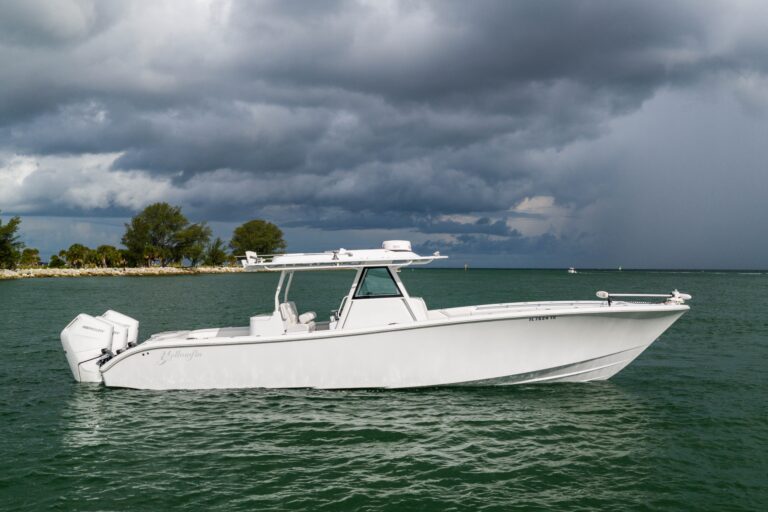
The 2022 Yellowfin 39 Offshore exemplifies a modern sportfish design engineered for blue water cruising. Yellowfin's offshore reputation, solid construction, and fuel capacity make it a credible choice for crews seeking speed (20+ knots) without sacrificing seaworthiness. Sportfish yachts consume more fuel than displacement trawlers but enable faster passages to distant cruising grounds.
The primary limitation of sportfish yachts for blue water cruising is comfort in heavy seas. Their planing hulls pound and pitch in large swells, increasing crew fatigue and motion sickness on extended passages. They're excellent choices for crews prioritizing speed and fishing capability; less ideal for those seeking maximum comfort in rough conditions.
What Should You Look For in a Blue Water Cruising Yacht Survey?
A comprehensive survey is essential when purchasing a blue water cruising yacht. Because these vessels operate in remote waters far from professional repair facilities, hidden structural or mechanical issues can become dangerous emergencies. Commission a detailed survey covering these areas:
Hull and Structural Integrity
- Fiberglass condition: Look for osmotic blistering (small bubbles under the gelcoat), cracks, or delamination indicating water intrusion.
- Keel attachment: Verify through-bolts are tight and show no corrosion or weeping. A loose keel is catastrophic offshore.
- Rudder post and steering system: Confirm the rudder moves freely, the post shows no cracks, and the steering mechanism has redundancy (wheel and tiller backup).
- Seacocks and through-hulls: All underwater fittings must be accessible, properly gasketed, and equipped with ball valves or seacocks. Confirm proper numbering and labeling.
- Deck and cabin: Check for soft spots indicating water intrusion, cracked windows or ports, and proper sealant around all deck penetrations.
Engine and Propulsion Systems
- Engine hours and maintenance history: Request complete service records. High hours (>3,000) may indicate impending major overhauls.
- Fuel system condition: Inspect fuel tanks for rust, sediment, or contamination. Verify fuel filters are accessible and properly sized.
- Cooling system: Confirm raw water intake is clear, zinc anodes are present and not depleted, and heat exchangers show no corrosion.
- Exhaust system: Check for corrosion, proper insulation, and secure through-hull fittings.
- Propeller and shaft: Inspect for corrosion, pitting, and proper alignment. Verify cutless bearing is not excessively worn.
Electrical and Navigation Systems
- Battery bank capacity and condition: Confirm sufficient amp-hours for extended cruising (typically 400+ AH for a 45-footer). Check for corrosion, proper sizing of cables, and isolation switches.
- Generator condition and fuel consumption: Verify generator runs smoothly, produces proper voltage, and has adequate fuel capacity.
- Navigation electronics: Confirm GPS, chartplotter, radar, and depth sounder function properly. Verify redundancy (two independent GPS sources, backup compass).
- Communication systems: Test SSB radio, satellite phone, or other long-range communication equipment.
- Wiring and panels: Confirm all circuits are properly labeled, breakers are appropriately sized, and no corrosion or loose connections exist.
Interior Accommodations and Systems
- Galley and head systems: Verify sinks, stove, refrigeration, and toilet function properly. Confirm water system includes pressure and manual options.
About this guide
General buying information from Fly Yachts, a yacht brokerage in Fort Lauderdale. Prices, costs and specifications are typical ranges, not quotes. Check any boat you are serious about with a survey and your own advisers.
All buying guides