Buying guide
Best Yacht for Shallow Water Cruising
The best yacht for shallow water cruising balances shallow draft—typically 2.5 to 4 feet depending on vessel type—with seaworthiness, comfort, and fuel efficiency. Monohull express cruisers, center-console designs, and purpose-built river yachts excel in shallow water, offering draft capabilities that deep-V offshore hulls cannot match. Key considerations include hull design (planing vs. displacement), engine configuration, beam width for stability in thin water, and whether you prioritize speed or efficiency. Shallow water cruising demands boats with reliable shallow-draft propulsion systems, good sight lines for navigation, and construction that withstands the structural stresses of running in skinny water. Budget ranges from $120,000 for compact 30-foot express cruisers to $3+ million for luxury shallow-draft motor yachts with full amenities.
What Hull Design Works Best in Shallow Water?
The hull design you select determines how effectively your yacht performs in shallow water conditions. Planing hulls—characterized by their ability to rise and skim across the water surface—are the gold standard for shallow water cruising because they maintain shallow draft even at speed. These hulls typically have deadrise angles of 15 to 25 degrees and rely on dynamic lift to reduce wetted surface area, which is essential when navigating waters under 4 feet.
Displacement or semi-displacement hulls, by contrast, sit deeper in the water and are better suited to deeper anchorages. They excel in fuel economy and seaworthiness in rough conditions but sacrifice the shallow-draft advantage that makes them impractical for true shallow water work.
Express cruisers and center-console designs dominate the shallow water market because their planing hull forms naturally draw less water than comparable-length trawlers or cruising motor yachts. The 2008 Sailfish 30-06 Express exemplifies this category—a 30-foot planing hull that achieves excellent shallow water performance while remaining affordable and easy to operate.
For larger shallow water cruising yachts, stepped hulls (featuring one or more steps in the hull bottom) reduce drag and improve efficiency by breaking the water flow into smaller pressure zones. This innovation allows larger vessels to maintain shallow draft without sacrificing speed or comfort—a critical advantage if you're considering a 40+ foot shallow water cruiser.
River yachts represent another specialized category. The 2007 Monticello 70 River Yacht is purpose-built for shallow water navigation on inland rivers and waterways, with design features specifically engineered for minimal draft and maximum interior volume in confined spaces.
How Much Draft Do You Actually Need to Avoid?
Draft requirements depend entirely on where you plan to cruise. Understanding the shallow water environments you'll navigate is non-negotiable when selecting a shallow water cruising yacht.
Coastal bays and estuaries (Chesapeake Bay, Galveston Bay, Florida's Gulf Coast) typically require 3 to 4 feet of draft. Most 30-foot express cruisers achieve 2.5 to 3.5 feet, making them suitable for these regions. Larger vessels often struggle here unless specifically designed for shallow water.
Inland rivers (Mississippi, Tennessee, Intracoastal Waterway) demand 2 to 3 feet of draft, depending on season and specific channel conditions. Purpose-built river yachts and shallow-draft trawlers excel here. The Monticello 70 River Yacht is engineered for these exact conditions, with draft specifications optimized for inland navigation.
Flats and backcountry (Florida's Ten Thousand Islands, Louisiana bayous, shallow Gulf flats) require 1.5 to 2.5 feet of draft. Only specialized center-console boats, shallow-draft skiffs, and ultra-light displacement cruisers work effectively in these environments.
Tidal considerations add complexity. Many shallow water cruisers run aground not because their draft exceeds available water, but because tidal fluctuations catch them unaware. A 3-foot-draft yacht is safe in 4 feet at high tide but vulnerable during low tide in the same location. Always factor in local tide ranges when planning shallow water cruising routes.
Modern GPS chartplotters display real-time water depth and often include historical tide data, making draft management far easier than in previous decades. However, no technology replaces understanding your vessel's draft specifications and the waters you'll navigate.
What Size Shallow Water Cruiser Makes Sense?
Vessel length directly correlates with draft, comfort, and operational complexity—and these factors create distinct size categories for shallow water cruising.
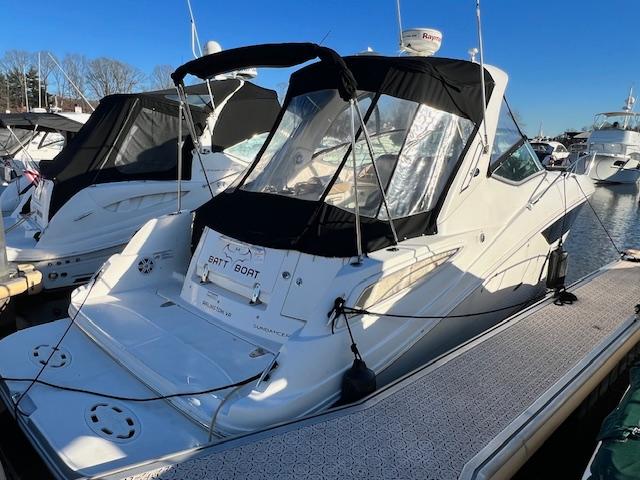
25 to 32 feet represents the sweet spot for many shallow water cruisers. These boats achieve 2.5 to 3.5 feet of draft, navigate easily in confined spaces, and offer reasonable cabin amenities for weekend and week-long cruising. Fuel consumption remains manageable, and single or twin outboard engines provide reliability and shallow-draft performance. The Sailfish 30-06 Express and 2017 Sea Ray Sundancer 330 exemplify this category—affordable, capable, and widely available on the used market.
33 to 45 feet allows for more spacious accommodations, enhanced seaworthiness in rough water, and greater fuel capacity for extended cruising. Draft typically ranges from 3 to 4.5 feet, which works well in most coastal and bay environments but becomes problematic in true backcountry. The 2012 Hunton XRS 43 balances performance and shallow water capability in this range, offering a high-speed planing hull with respectable draft performance.
46 to 60 feet introduces luxury accommodations, larger fuel tanks, and advanced navigation systems, but draft typically increases to 4 to 5 feet. At this size, shallow water cruising becomes specialized rather than primary. Vessels in this range work best in deeper coastal and bay environments. The 2009 Sabre 52 Express represents quality construction and performance at this size, though it's better suited to deeper water cruising than true shallow water work.
60+ feet generally exceeds practical shallow water performance unless the vessel is specifically designed as a river yacht or ultra-shallow-draft trawler. At this size, the Monticello 70 River Yacht proves that purpose-built design can achieve shallow water capability even at larger LOAs, but this represents specialized construction rather than a typical luxury motor yacht.
Which Propulsion Systems Perform Best in Shallow Water?
Engine type and propulsion configuration directly impact shallow water performance and operational costs. Your choice between outboards, inboards, and jet drives shapes both draft and long-term ownership experience.
Outboard engines dominate shallow water cruising for good reason. Outboards draw minimal water—often 1.5 to 2 feet depending on engine size—and their shallow-draft mounting makes them ideal for boats under 35 feet. Outboards also offer reliability, easy maintenance, and straightforward troubleshooting. Twin or triple outboard setups provide redundancy; if one engine fails, you maintain propulsion. Modern four-stroke outboards achieve reasonable fuel economy while delivering the power needed for planing hull performance.
Jet drives (water jets) represent the ultimate shallow water solution, capable of operating in water as shallow as 1 foot by design. Jet drives eliminate the prop and shaft, reducing draft to the intake opening. However, jet drives sacrifice fuel efficiency and are primarily found on specialized center-console boats and military vessels rather than cruising yachts. They're also expensive to maintain and repair.
Inboard/outboard (I/O) drives split the difference—the engine sits inside the hull (reducing draft compared to traditional inboards), while the outdrive extends through the transom. I/O drives achieve 2.5 to 3.5 feet of draft on most cruising yachts and offer good power and efficiency. They're common on express cruisers and cabin cruisers in the 30 to 45-foot range.
Traditional inboard engines with shaft-and-strut propulsion require 4 to 6+ feet of draft and are unsuitable for serious shallow water cruising. They're found primarily on larger displacement cruisers and trawlers designed for deeper water navigation.
For shallow water cruising yachts, outboard-powered boats under 35 feet and I/O-powered express cruisers in the 35 to 45-foot range represent the practical sweet spot. These configurations balance draft performance with reliability, comfort, and reasonable fuel consumption.
What Should I Look For in a Survey?
A pre-purchase survey for a shallow water cruising yacht must address factors specific to shallow water operation—structural integrity under the stresses of running in thin water, propulsion system reliability, and hull condition assessment.
Hull bottom inspection is paramount. Shallow water cruising inevitably involves occasional groundings or running over sandbars. Look for evidence of prior impact damage, including cracks in the hull, delamination (separation of the fiberglass layers), or soft spots in the bottom. A surveyor should use moisture meters to detect water intrusion into the hull structure, which is common in older shallow water boats that have spent years in saltwater or brackish environments.
Propulsion system evaluation requires detailed inspection of engines, drives, and fuel systems. In shallow water boats, outboards and I/O drives experience higher stress from running in thin water and occasional impacts. Request compression tests on all cylinders to verify engine health. Check for corrosion in fuel tanks—saltwater and brackish water environments accelerate internal tank degradation. Verify that the fuel system includes proper filtration and water-separation equipment, which is essential in shallow water where sediment and organic matter can clog fuel systems.
Structural integrity becomes critical in boats that have operated extensively in shallow water. Shallow water running creates different hull stresses than deep water cruising; the boat experiences more impact loading and vibration. A surveyor should assess the condition of stringers, frames, and bulkheads—the internal structural components that prevent hull flexing. Look for cracks in the cabin structure, misaligned doors or windows (indicating hull flexing), or visible stress marks in the cabin sole.
Electrical and navigation systems matter more in shallow water boats, where precise depth awareness prevents groundings. Verify that the boat includes functioning depth sounders, GPS chartplotters, and backup navigation equipment. Test all systems personally; a non-functioning depth sounder is a serious liability in shallow water.
Corrosion assessment is essential for any boat with saltwater or brackish water exposure. Shallow water environments often include brackish water, which accelerates corrosion of aluminum components, steel fasteners, and electrical connections. Request a detailed corrosion survey, particularly for aluminum fuel tanks, engine blocks, and through-hull fittings.
The survey should also verify that the boat's construction and design are appropriate for the shallow water environments you plan to navigate. A surveyor familiar with shallow water boats will identify design shortcomings that might not be obvious to someone experienced only with deep water yachts.
What Does It Cost to Own a Shallow Water Cruising Yacht?
Ownership costs for shallow water cruising yachts vary dramatically based on size, age, and propulsion system, but understanding the full financial picture is essential before purchase.
Purchase price ranges from $120,000 for a used 30-foot express cruiser to $3+ million for newer luxury shallow-draft motor yachts. The Sailfish 30-06 Express at $120,000 represents the entry point for capable shallow water cruising, while mid-size options like the 2017 Statement 380 Open at $299,000 offer more space and amenities. Larger vessels like the 2023 Horizon PC60 at $3.195 million represent the luxury shallow-draft market.
Fuel costs depend on engine type and cruising speed. Outboard-powered boats in the 25 to 35-foot range typically consume 15 to 25 gallons per hour at cruising speed, translating to $75 to $150 per operating hour at current fuel prices. Larger express cruisers and I/O-powered boats consume 25 to 50 gallons per hour, increasing fuel costs proportionally. Shallow water boats that spend significant time at idle speed (navigating through narrow channels and shallow areas) often achieve better fuel economy than their deep water counterparts, which can cruise at higher speeds.
Maintenance and repairs average 5 to 10% of the boat's purchase price annually for older boats (15+ years) and 3 to 5% for newer vessels. Outboard engines require regular oil changes, spark plug replacement, and impeller maintenance. I/O drives need annual service of the outdrive unit, including oil changes and seal inspections. Hull maintenance includes bottom painting every 2 to 3 years (essential in saltwater and brackish water), waxing, and regular inspection for damage.
Insurance typically costs $1,000 to $3,000 annually for a $300,000 boat, with rates varying based on the boat's age, your experience, and the waters where you operate. Shallow water boats may attract slightly higher premiums due to perceived grounding risk, though this varies by insurer.
Storage and mooring costs range from $100 to $300 monthly for dry storage at a boatyard (more expensive for larger boats) to $200 to $500 monthly for wet slip mooring at a marina. Shallow water boats often benefit from lower mooring costs since they can access less-developed anchorages and smaller marinas.
Haul-out and bottom work costs $2,000 to $8,000 per occurrence, depending on boat size. Shallow water boats should be hauled annually for inspection and maintenance, making this a recurring expense.
Total annual ownership costs typically range from $15,000 to $40,000 for a $300,000 shallow water cruiser, including fuel, maintenance, insurance, and storage. Larger or older boats push toward the higher end of this range.
About this guide
General buying information from Fly Yachts, a yacht brokerage in Fort Lauderdale. Prices, costs and specifications are typical ranges, not quotes. Check any boat you are serious about with a survey and your own advisers.
All buying guides