Buying guide
Best Yacht for Wide Open Water
Wide-open water demands a yacht engineered for rough conditions, fuel efficiency, and seaworthiness—not just comfort. The best yachts for this purpose combine deep-V hulls, offshore-grade construction, reliable diesel engines, and proven stability in heavy seas. Boats in the 39–50-foot range offer the optimal balance of capability, range, and manageable crew requirements. Key factors include hull design that cuts through chop rather than pounding, fuel capacity for extended range, redundant safety systems, and a wheelhouse design offering 360-degree visibility. Offshore-rated sportfishing and express cruisers from established builders like Yellowfin, Viking, and Cabo dominate this category because they're built to DNV or ABS standards, feature solid construction practices, and have proven track records in blue-water conditions. Budget $500,000–$2 million for a quality used or new offshore yacht, plus 8–12% annually for ownership costs.
What Hull Design Works Best for Wide-Open Water?
A deep-V hull is non-negotiable for wide-open water performance. This design pushes the boat's deadrise angle—typically 20–25 degrees at the transom—to cut through waves rather than slam into them, reducing pounding and improving comfort in rough seas. The deep-V geometry also provides better directional stability and reduces hobby-horsing (the up-and-down pitching motion that exhausts crews and damages equipment).
Look for hulls with a pronounced keel line and a narrow entry forward. This combination ensures the yacht knifes through chop and maintains control in quartering seas. Many offshore-capable yachts also feature spray rails or chines that direct water away from the windshield and cabin, keeping the vessel drier and safer in heavy conditions.
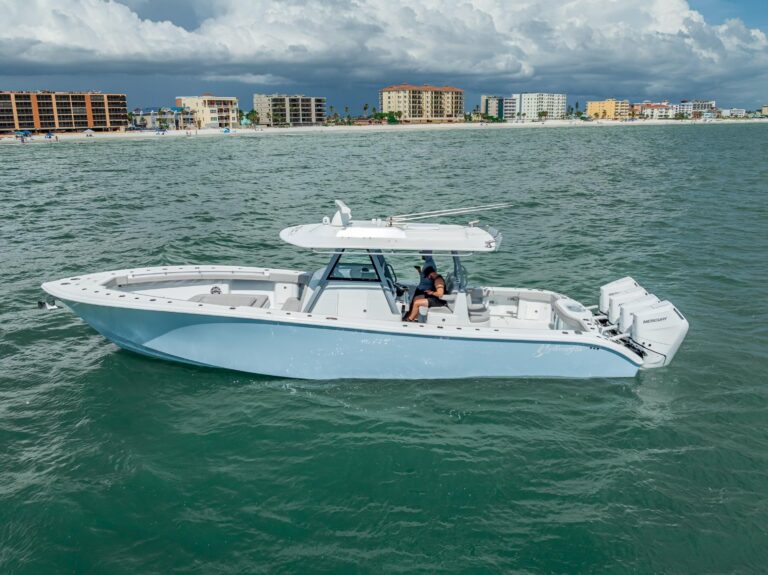
The 2024 Yellowfin 39 Offshore exemplifies this principle—its proven deep-V hull is engineered specifically for offshore conditions, with a design that has logged thousands of hours in Atlantic and Gulf waters. Yellowfin's construction standards and hull shape make it a benchmark for wide-open water capability in the 39-foot class.
Avoid flat-bottomed or moderate-V designs if you plan to operate regularly in seas over 4 feet. Those configurations work for calm bays and rivers but will pound excessively and reduce safety margins in genuine offshore conditions. Equally important is the boat's beam-to-length ratio; narrower beams relative to length improve rough-water handling, though they sacrifice some interior volume.
What Engine and Fuel Capacity Do You Need for Offshore Range?
Offshore yachts in the 39–50-foot range typically use twin diesel engines producing 350–600 horsepower each, offering the balance between fuel efficiency and adequate power for sea state management. Diesel engines are mandatory for wide-open water because they deliver superior fuel economy, run cooler, and provide the torque needed to maintain steerage in heavy following seas.
Fuel capacity is critical for wide-open water cruising. A 39-foot offshore yacht should carry a minimum of 500–700 gallons; 44-footers typically hold 800–1,200 gallons. At 60% throttle (the efficient cruising speed for offshore work), a twin-diesel 44-footer burns roughly 15–20 gallons per hour, translating to a 2,000+ nautical mile range. This range allows you to reach distant fishing grounds, weather windows, or safe harbors without refueling at marginal fuel docks.
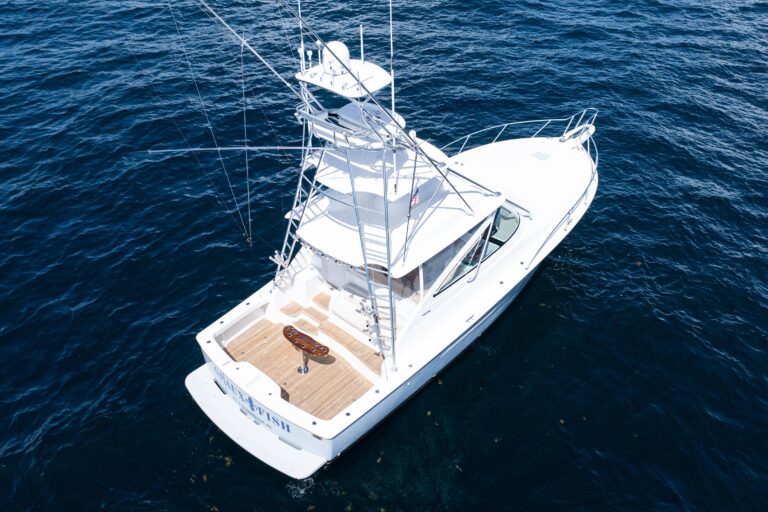
The 2019 Viking 44 Open features twin diesel engines and substantial fuel capacity, delivering the range and reliability required for extended offshore operations. Viking's reputation for engine room access and maintenance-friendly layouts is a significant advantage for owners who plan serious blue-water use.
Verify that the yacht has fuel polishing systems, redundant fuel filters, and water-separation capability. Contaminated fuel is a leading cause of offshore breakdowns. Also confirm that the fuel system includes baffles and proper venting to prevent sloshing and air entrainment in rough seas.
How Important Is Wheelhouse Design and Visibility?
A proper offshore wheelhouse—not merely an open helm—is essential for wide-open water safety and crew endurance. The wheelhouse should enclose the helm station, protect operators from wind and spray, and provide 360-degree visibility through laminated glass windows. Laminated glass resists impact from waves and flying debris, unlike tempered glass used in many coastal cruisers.
The helm seat must be elevated and positioned to see the bow and both quarters without standing. This positioning allows the captain to read sea state, spot weather changes, and respond quickly to hazards. Look for a wheelhouse with a hardtop that extends well forward of the helm, offering shade and spray protection during day-long offshore runs.
Radar, GPS plotter, and autopilot integration should be seamless and visible from the helm. In wide-open water, the navigator often operates alone for hours; poor instrumentation layout creates fatigue and errors. Confirm that all critical gauges (engine temps, pressures, fuel consumption, battery voltage) are mounted at eye level and backlit for night operations.
Ventilation is often overlooked but crucial. A wheelhouse that fogs up or becomes stuffy forces the operator to open windows, defeating the purpose of enclosure. Look for defroster capability and passive air vents positioned to prevent rain ingress.
What Construction Standards Should You Verify?
Offshore-rated yachts should be built to DNV (Det Norske Veritas) or ABS (American Bureau of Shipping) standards, or at minimum comply with ABYC (American Boat & Yacht Council) guidelines. These standards govern hull lamination, structural reinforcement, fastener quality, and systems redundancy. A yacht built to DNV standards has undergone third-party inspection of mold construction, resin selection, and layup schedules—significantly reducing the risk of delamination or structural failure in heavy seas.
Inspect the hull for signs of crazing (fine cracks in the gel coat) or osmotic blistering, which indicate moisture intrusion and poor resin chemistry. For a yacht you're considering for wide-open water use, hire a marine surveyor with offshore experience and require a moisture meter survey of the hull.
The engine room should feature robust stringers, properly bonded through-hull fittings, and redundant seacocks for every through-hull penetration. In heavy weather, a single failed through-hull can sink a boat; offshore vessels must have isolation seacocks that allow closure without accessing the hull exterior.
Check that the cabin sole (floor) is solid fiberglass or marine plywood, not particle board, which absorbs water and fails rapidly. Structural bulkheads should be bonded to the hull and deck, not merely glassed over the surface. These details separate a boat that can survive a knockdown from one that might not.
What Size Yacht Is Practical for Wide-Open Water?
The 39–50-foot range represents the practical sweet spot for wide-open water operation. Boats smaller than 35 feet lack the fuel capacity, freeboard, and motion-dampening mass for safe extended offshore work. Boats larger than 55 feet require larger crews, higher fuel consumption, and more complex systems—advantages that diminish unless you're operating a commercial charter or expedition vessel.
A 39-footer can be operated safely by a two-person crew during day trips and managed by one competent skipper in favorable conditions. A 44–50-footer offers more cabin comfort, larger fuel and water tanks, and better sea-keeping but begins to demand professional crew or significant owner experience.
Consider the docking situation at your home port. A 39-footer fits most municipal slips and private marinas; a 50-footer may be restricted to premium slips or require anchoring out. Fuel dock access also matters—some remote fuel docks cannot accommodate boats over 45 feet.
What Safety Systems Are Non-Negotiable for Offshore Yachts?
Wide-open water demands redundancy in every critical system. The yacht must have dual batteries with automatic changeover, dual engine alternators, and a backup electrical system capable of powering navigation and bilge pumps if the main engines fail. A 24-hour sea anchor (drogue) should be aboard and secured where it's accessible in rough conditions.
Life raft capacity must equal 125% of all persons aboard. The raft should be serviced annually and stored in a canister, not an inflatable valise. Confirm that the yacht carries an EPIRB (Emergency Position Indicating Radio Beacon) registered with the Coast Guard, a personal locator beacon (PLB) for each crew member, and a satellite communicator (Iridium or similar) for areas beyond cell coverage.
Fire suppression systems should include galley hood suppression, engine room dry-powder or Halon systems, and portable CO₂ extinguishers throughout. Inspect the engine room access—you must be able to reach any engine compartment fire without removing panels or tools in an emergency.
The yacht should have a watertight collision bulkhead forward, proper freeboard (the height of the hull above the waterline), and a solid cabin trunk that prevents water from flowing aft during a knockdown. A proper hard dodger or wheelhouse is far safer than an open helm in wide-open water.
How Much Does It Cost to Own an Offshore Yacht?
Purchase price for a quality wide-open water yacht ranges from $500,000 for a used 39-footer to $2+ million for a new 50-footer. The 2024 Yellowfin 39 Offshore at $599,000 represents excellent value for a new, offshore-ready platform. Used models 5–10 years old often deliver 70–80% of new-boat capability at 50–60% of the price.
Annual ownership costs—fuel, insurance, maintenance, haul-out, and storage—typically run 8–12% of the purchase price. For a $600,000 boat, budget $48,000–$72,000 yearly. Fuel costs alone can reach $20,000–$30,000 annually if you run 200+ hours per year. Insurance for an offshore-capable yacht costs $4,000–$8,000 yearly, depending on the captain's experience and the vessel's use profile.
Engine overhauls represent the largest deferred maintenance cost. Diesel engines typically require overhaul at 5,000–8,000 hours; expect $15,000–$25,000 per engine. Hull haul-out and bottom paint every 18–24 months runs $3,000–$6,000 depending on the yard and the boat's size.
Financing is available through marine lenders at 5–7% interest for 10–15-year terms, though rates vary with credit profile and the boat's age. A $600,000 purchase financed at 6% over 12 years costs roughly $5,900 monthly before insurance, fuel, and maintenance.
What Should You Look for in a Survey?
For a wide-open water yacht, hire a surveyor certified by SAMS (Society of Accredited Marine Surveyors) with specific offshore or sportfishing experience. The survey must include a haul-out for hull inspection, moisture meter testing, through-hull examination, and a comprehensive engine compression and sea trial.
Verify that the surveyor inspects the rudder post, prop shaft, and through-hull fittings for corrosion and proper sealing. Request a detailed report on the condition of the cabin sole, structural bulkheads, and any evidence of water intrusion. A moisture reading above 25% in the hull laminate indicates delamination risk and should trigger negotiation or rejection.
The sea trial is critical. Operate the yacht in at least 3–4-foot seas to assess handling, engine performance, and noise levels. Check that the steering is responsive, the engines hold RPM without hunting, and there are no unusual vibrations or sounds from the engine room. Run the engines at cruise RPM for at least two hours to confirm stable operation and fuel consumption.
Request a full engine survey if the yacht has more than 3,000 hours or if the engines have not been serviced recently. Compression testing, borescope inspection, and fuel system analysis are worth the $1,500–$2,500 cost to avoid a $50,000 engine overhaul post-purchase.
Which Builders Are Known for Offshore Capability?
Yellowfin, Viking, Cabo, Contender, and Grady-White dominate the offshore yacht market because they have decades of experience, proven hull designs, and a commitment to construction quality. Yellowfin specializes in offshore sportfishing boats with exceptional seaworthiness; Viking combines sportfishing capability with cruising comfort; Cabo excels in larger offshore express cruisers.
Smaller builders like Regulator, Everglades, and Pathfinder also produce capable offshore boats, but they typically focus on the 35–42-foot range. If considering a boat from a lesser-known builder, verify that it has been used offshore by multiple owners and that parts and service support are available in your region.
Avoid production boats designed primarily for calm-water use, even if they're large. A 50-foot bay boat or center console is not safer offshore than a 39-foot deep-V express designed for the ocean. The hull shape, freeboard, and systems design matter far more than overall size.
How Does Fly Yachts Help You Find the Right Offshore Yacht?
Fly Yachts specializes in matching buyers with yachts suited to their actual use—whether that's weekend coastal cruising or serious blue-water operation. Our brokers have offshore experience and understand the differences between a capable bay boat and a true offshore platform.
About this guide
General buying information from Fly Yachts, a yacht brokerage in Fort Lauderdale. Prices, costs and specifications are typical ranges, not quotes. Check any boat you are serious about with a survey and your own advisers.
All buying guides